
by: Leonardo Corbucci 25 Gennaio 2024 7:33
Trends 2024 in Photovoltaics: Inverters and Batteries.
What to expect from this new year in PV? Inveco Group explores the new dynamics of 2024.
In the dynamic landscape of solar energy, 2024 emerges as a pivotal year for the photovoltaic sector, marked by a series of new trends that are reshaping the future of sustainable energy.
From innovative technologies to changes in regulatory frameworks, this insight, guided by the expertise of the Inveco team, will explore the latest developments in the field of photovoltaics. It offers a glimpse into the innovations shaping the industry and contributing to making solar energy increasingly accessible and efficient.
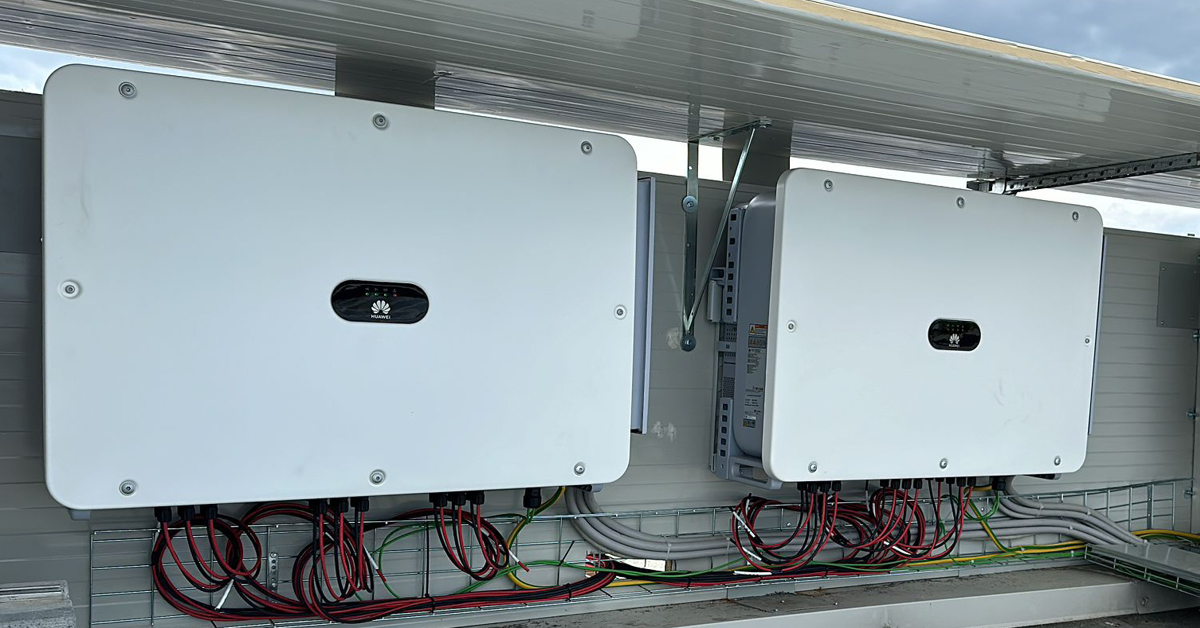
Analysis from Technology Provider Huawei.
Emerging technologies, coupled with the necessary energy transition, will bring significant attention and momentum to renewable energy production.
In this scenario, solar energy will take center stage; here are the trends in the photovoltaic sector for 2025.
According to an analysis by Huawei, the European Union is pushing towards a green path for growth with its Green Deal: initiatives and funding to stimulate the energy transition towards renewables, to help combat climate change, and to provide people with valuable opportunities for training and requalification in the green economy.
This represents an unmissable opportunity, supported by an investment plan that, driven by the need to support recovery after the health emergency leading to an unprecedented economic and social crisis, will bring substantial financial resources to the table.
An opportunity not to be missed and fully exploited.
In this scenario, which will impact the next 5-10 years, the production of energy from renewable sources will play a crucial role in the continental energy mix.
Especially for solar energy, undoubtedly the most easily developable green energy source, a bright future is predicted.
For this reason, since solar energy will likely constitute a significant portion of total green energy production, ensuring its security, reliability, and a favorable cost-benefit ratio will be essential.
The trends in the photovoltaic sector in Italy.
In the next ten years in our country, we will need to add 30 GW of new installed capacity to reach the target set by the international community. To achieve this, technology must be widely used in the management of photovoltaic systems.
Thanks to emerging technologies – artificial intelligence, cloud computing, big data analysis, and 5G – which will undoubtedly have significant impacts in the energy sector, at least 10 trends in the photovoltaic sector in Italy can be anticipated.
The forecast, provided by Huawei, a company with over 120 GW installed globally through its inverters, has taken into account four fundamental factors:
> The weighted average cost of electricity (LCOE).
> Compatibility with the electrical grid.
> Intelligent convergence.
> Security and reliability.
Digitalization of Photovoltaic Systems.
Despite the rapidly growing photovoltaic market, there are still many outdated devices in photovoltaic installations, both in terms of energy generation and communications.
These devices cannot be effectively monitored, nor can they report malfunctions. With the rapid development of digital technologies such as 5G and cloud computing, it is expected that 90% of photovoltaic installations will be fully digitized by 2025, making their management simple, intelligent, and efficient.
Artificial Intelligence and Photovoltaics.
The deep integration of artificial intelligence into photovoltaics will facilitate mutual detection and interconnection between devices, improving electricity production and O&M efficiency through collaborative optimization.
Artificial intelligence can provide new advantageous opportunities for photovoltaic systems, such as proactive identification and prevention of faults in photovoltaic modules and inverters using AI diagnostic algorithms.
Optimizing the tracker algorithm to handle large volumes of plant data and machine learning will lead to higher yields, combined with the synergy of solar energy storage assisted by AI to automatically optimize the profitability of the photovoltaic system.
As LCOE continues to decrease, and O&M complexity consequently increases, AI is likely to be widely employed in photovoltaic installations.
With the proliferation of AI and the Internet of Things (IoT), intelligent products and services will make the entire photovoltaic solution more advantageous.
With the advent of continuous self-learning algorithms, AI will be extensively used to replace O&M experts in many diagnostic and decision-making functions.
Inspections using drones and automated O&M based on robots will manage hazardous and repetitive O&M tasks that require a high and continuous degree of precision, enhancing productivity and safety in photovoltaic installations.
Projections of BESS Battery Cost Reductions and NREL Data.
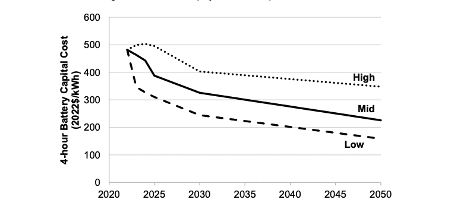
The National Renewable Energy Laboratory (NREL) of the United States has updated the long-term costs of Lithium-Ion Battery Energy Storage Systems (BESS) up to 2050, with potential costs potentially halved within a decade.
The national laboratory provided the analysis in its ‘Battery Storage Cost Projections: 2023 Update,’ forecasting how BESS capital expenditure costs will change from 2022 to 2050.
The report is based on data collected and projections from numerous other publications, using the example of a Lithium-Ion BESS (4-hour system).
A recent analysis by Bloomberg NEF also found that BESS costs have decreased by 2% in the last six months, following peaks in 2022.
Compared to 2022, the national laboratory states that BESS costs will decrease by 47%, 32%, and 16% by 2030, respectively, in its ‘low,’ ‘medium,’ and ‘high’ segment projections.
By 2050, costs could decrease by 67%, 51%, and 21% in the three projections, respectively.
These reductions would result in costs of $255/kWh, $326/kWh, and $403/kWh by 2030, and $159/kWh, $237/kWh, and $380/kWh by 2050.
A significant factor in reducing BESS costs will be the decrease in the costs of cells and battery packs, which make up about half of the overall cost of lithium-ion batteries.
The research company Fastmarkets recently predicted that the average prices of lithium-ion batteries using lithium iron phosphate (LFP) cells will drop to $100 USD/kWh by 2025, with nickel manganese cobalt (NMC) reaching the same threshold in 2027.
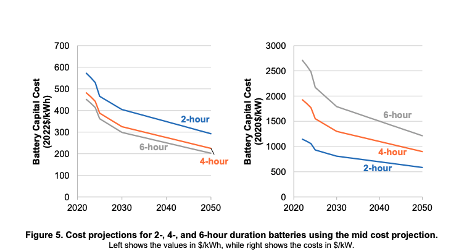
NREL has also highlighted that the ‘Power Electronics – Inverter’ components of a BESS have different cost curves based on their duration.
On a US$/kWh basis, longer-duration batteries (slow charge and discharge cycles) have lower capital costs, while on a US$/kW basis, shorter-duration batteries (fast charge and discharge cycles) turn out to be more expensive.
Both of these points are visualized in the following charts:
Global Analysis of the BESS Market.
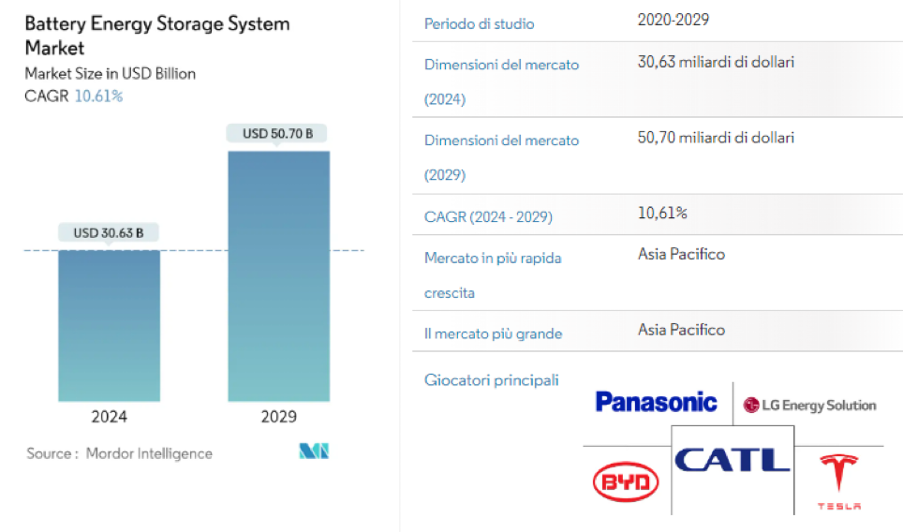
The size of the global battery energy storage systems market is estimated to be $30.63 billion in 2024 and is expected to reach $50.70 billion by 2029, growing at a CAGR of 10.61% during the period 2024-2029.
After the negative impact of COVID-19 in 2020, the market has currently recovered to pre-pandemic levels, gearing up for a promising forecast period.
In the medium term, factors such as the decline in prices of lithium-ion batteries and increased penetration of renewable energies will drive the energy storage systems market.
However, the imbalance in the supply and demand of raw materials such as cobalt, lithium, copper, etc., will be the primary obstacle to the growth of the BESS market.
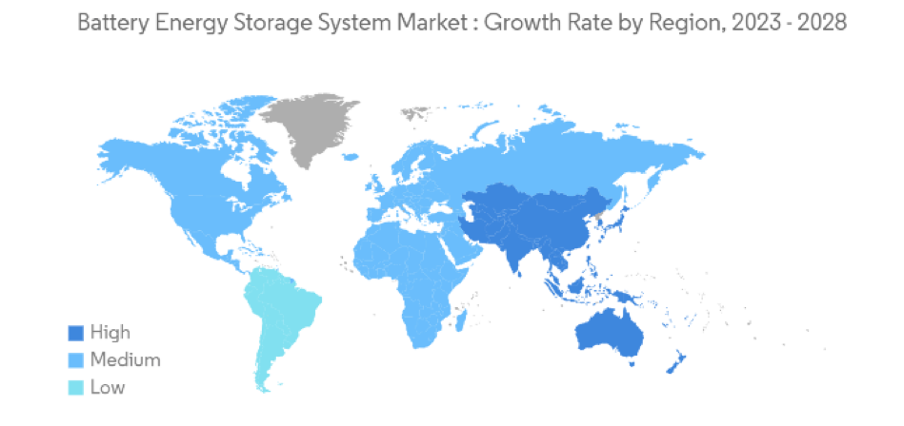
The Asia-Pacific region emerges as the fastest-growing market during the forecast period due to the increasing demand for energy.
This growth is attributed to rising investments, coupled with supportive government policies in countries within this region, including India, China, and Australia.
Within this region, there are both highly developed countries like Japan, South Korea, New Zealand, and Australia, boasting advanced networks, functioning well, and utilizing the latest technologies.
There are also developing countries experiencing rapid population growth and urbanization, leading to an increased demand for electricity.
Developing countries are expected to incorporate significant amounts of energy into their grids, given the cost-effectiveness of renewable implementation.
Many areas will adopt a more distributed approach to network development, utilizing increased local energy production and micro-grid systems, laying the groundwork for the growth of the energy storage systems market.
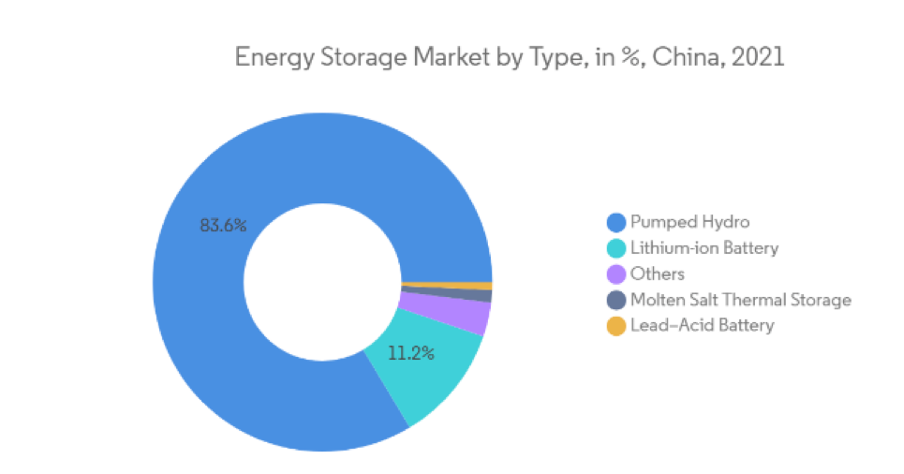
And then there is China: if the Chinese government’s political plan aims to increase the country’s energy storage capacity to 100 GW by 2030 (from 3.2 GW in 2021) to achieve the government’s net-zero emissions goal by 2060, it may not convince the skeptics. There is no doubt that the ‘world’s factory’ is already a leader in battery production.
For example, in 2021, China’s total battery production capacity was approximately 558 GWh, while the global battery production was around 600 GWh in the same year.
The size of the battery energy storage systems market in North America is estimated at $3.91 billion in 2024 and is expected to reach $15.28 billion by 2029, growing at a CAGR of 31.28% during the period.
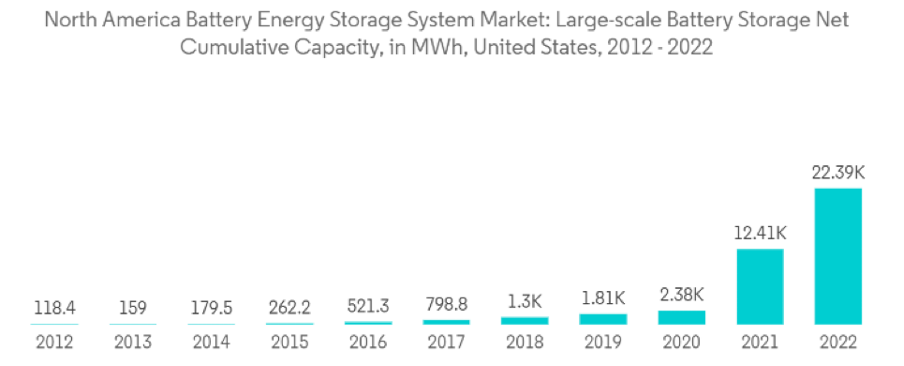
The United States dominates the market in the region. The battery energy storage system (BESS) in the United States has undergone significant changes in recent years, especially in the residential and commercial sectors, supported by growing investments in renewable energy infrastructure.
In 2022, the cumulative capacity of large-scale battery storage was approximately 22,385.1 megawatt-hours (MWh), about 80% more than in 2021, according to the U.S. Energy Information Administration.
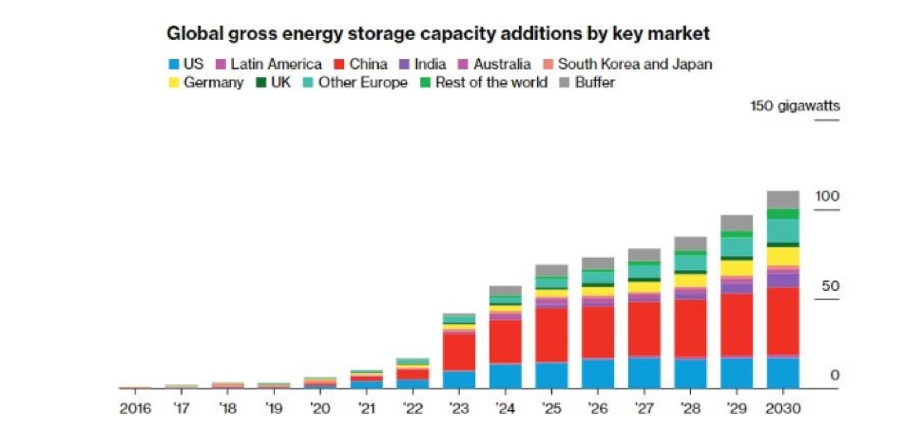
Although the European market currently represents one-third of the global market, with a European market size of $11.10 billion in 2023, it is expected to grow only to $12.05 billion by 2028, with a CAGR of 1.67% during the forecast period (2023-2028).
According to the European Association for Energy Storage (EASE), Europe will need approximately 187 GW of energy storage by 2030, with battery storage accounting for 122 GW of capacity.
Case Study Hotel Gardenia Srl
What impact can an energy storage system have on a hospitality facility like a hotel during a winter month?
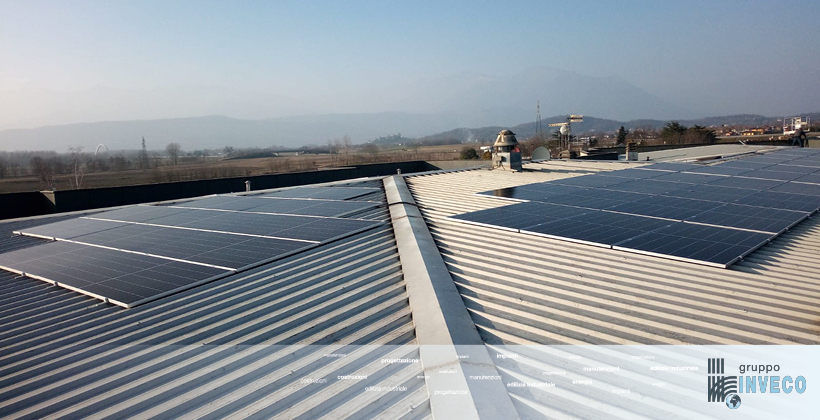
Hotel Gardenia has a multi-exposure photovoltaic system on the roof, with a capacity of 40.68 kW consisting of 72 Jinko Solar photovoltaic modules with a capacity of 565 W each. The system is equipped with 3 Huawei SUN2000-10KTL-M1 inverters to manage the produced power, and 6 Huawei Luna2000 batteries with a capacity of 5 kWh each to supply surplus energy when needed.
Let’s take a look at a chart related to a typical day in a winter month like November:
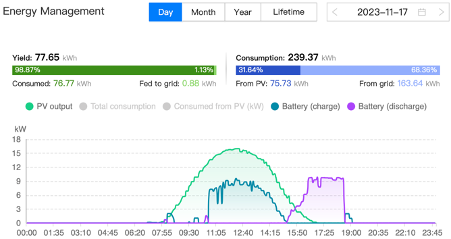
In green, we see the photovoltaic production curve, in blue, we can observe the battery charging period, while in purple, the battery discharge period is graphed.
The photovoltaic system starts producing energy, allowing the hotel to self-consume the generated energy and charge the batteries during the peak production period, from 11 AM to 3 PM.
Let’s compare the above chart with the consumption:
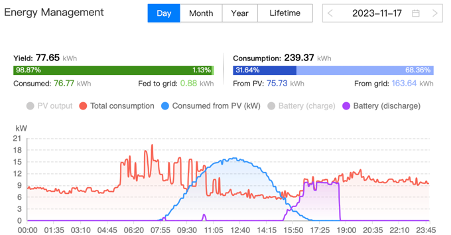
We observe that from 8:00 in the morning until around 7:00 in the evening, the consumption curve experiences a dip, lowering in response to significant energy demand.
The batteries start releasing the accumulated energy as soon as the charging ends and the demand requires it, which occurs around 3:10 PM.
We note that from 3:00 to 6:00, the batteries were able to release energy continuously and steadily.
We can therefore assert that in a winter month, generally unfavorable due to lower solar radiation and higher consumption, the photovoltaic system combined with a battery pack is capable of extending the inverted Gaussian of consumption, promoting energy and cost savings.
In conclusion, 2024 appears to be an exciting year for the photovoltaic sector, with a series of trends promising to redefine the future of sustainable energy.
From technological innovations improving the efficiency of solar panels to the increasing adoption of integrated and intelligent solutions, photovoltaics are undergoing an unprecedented transformation.
Insight provided by the CEO of Inveco Group; Dr. Filippo Barbetti, Eng. Andrea Girelli, Giuseppe Gallo – Technical Office, and Emanuele Massafra.
Recent Posts
Categories
